van Waerbeke & Heymans "see" dark matter
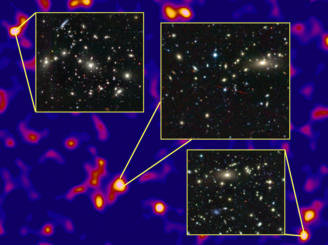 For the first time, astronomers have mapped dark matter on the largest scale ever observed. Catherine Heymans and Ludovic Van Waerbeke of UBC presented their analysis of the gravitational lensing of about 10 million galaxies in four regions of the sky to the American Astronomical Society meeting in Austin, Texas on 2012-01-08.
The analysis reveal a Universe comprised of an intricate cosmic web of dark matter and galaxies that spans more than one billion light years. The dark matter is distributed as a network of gigantic dense areas, with less matter distributed in filament-like structures & large empty regions.
Catherine Heymans is a former postdoc in P&A, and is now a Lecturer at the University of Edinburgh, Scotland. Ludovic Van Waerbeke is an Associate Professor in the dept & has been with us since 2005. An international team of researchers also contributed to the project.
The project, known as the Canada-France-Hawaii Telescope Lensing Survey (CFHTLenS), uses data from the Canada-France-Hawaii Telescope Legacy Survey. It accumulated images over five years using the wide field imaging camera MegaCam, a 1 degree by 1 degree field-of-view 340 Megapixel camera on the CFHT in Hawaii. Galaxies included in the survey are typically six billion light years away. The light captured by the telescope images used in the study was emitted when the Universe was six billion years old - approximately half the age it is today.
The dark matter mapping project was considered the top 8 most important science story by the Discover Magazine in 2012.
See the following links for more details,
- CFHT Press Release
- BBC online story Dark matter's cosmic web revealed