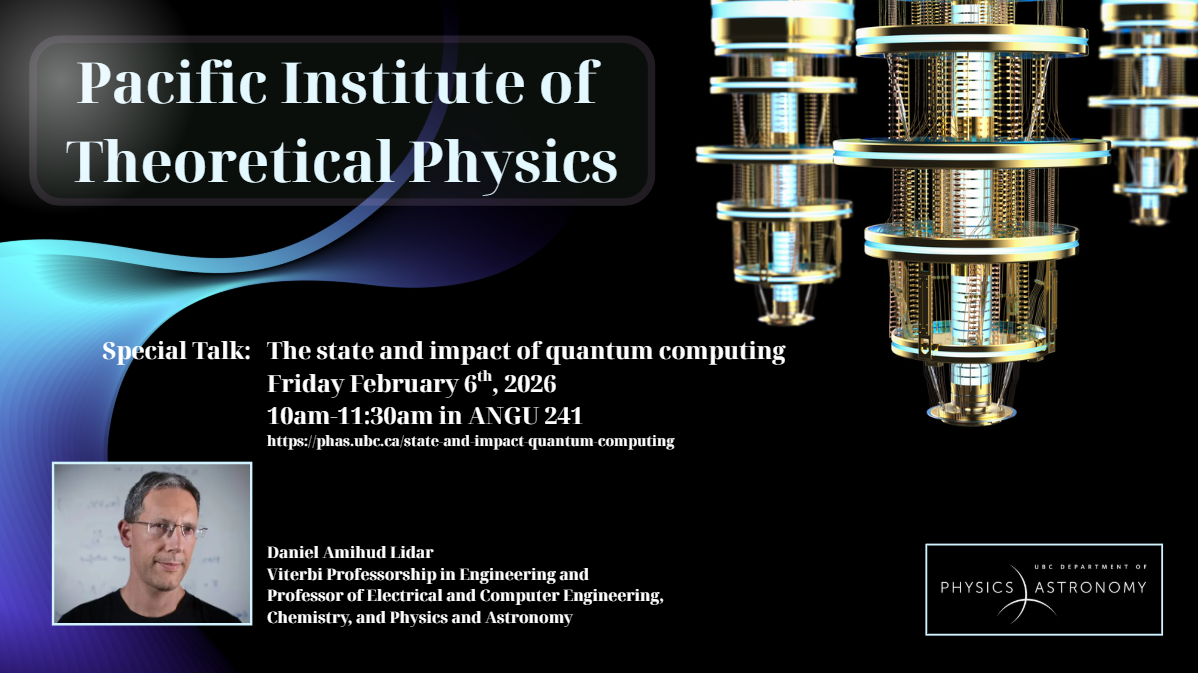
The state and impact of quantum computing
Contact Swarn Rai: pitpoffice@physics.ubc.ca
All are welcome to this event!
- Zoom: https://ubc.zoom.us/j/66526509080?pwd=IKgwWIrVR0lawM4SaaVlVfVHOsKxbP.1
Meeting ID: 665 2650 9080
Passcode: 982880
Abstract:
Despite nearly three decades of intensive worldwide research and substantial investment, large-scale universal quantum computers capable of solving hard computational problems remain elusive. However, significant progress has been made in developing special-purpose quantum information processors. These include quantum simulators—originally envisioned by Feynman to model complex quantum systems—and quantum annealers, designed to accelerate the solution of classical optimization problems.
Recent years have witnessed remarkable milestones in demonstrating quantum advantages. "Quantum supremacy" experiments have shown that current quantum devices can perform specific tasks beyond the reach of classical supercomputers, albeit for problems without immediate practical applications. Another ambitious goal is achieving "algorithmic quantum speedup"—demonstrating quantum advantage for computational problems with known theoretical separations between quantum and classical complexity.
This talk will examine these developments and their implications for the field, addressing both near-term applications and long-term prospects for quantum computing. Central to this discussion is the critical challenge of error mitigation and decoherence suppression, which remains the primary obstacle to scaling quantum systems. I will discuss current strategies for overcoming these limitations in the context of demonstrating quantum advantage using today’s noisy quantum processors.
Bio:
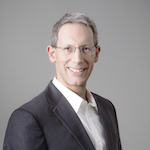
Daniel Lidar is the holder of the Viterbi Professorship of Engineering at the University of Southern California and researches quantum information processing. He holds joint appointments in the departments of Electrical & Computer Engineering, Chemistry, and Physics & Astronomy. He is the scientific director of the USC Center for Quantum Computing (which possesses a d-wave computer) co-founder and director of the USC Center for Quantum Information Science & Technology, and the director of the USC-IBM Quantum Innovation Center. He did his postdoctoral work at UC Berkeley after receiving his Ph.D. in Physics from the Hebrew University of Jerusalem in 1997. Prior to joining USC in 2005, he was a faculty member at the University of Toronto for five years.
Daniel Lidar is, amongst other things, very well known for his work in quantum computation, notably his work on decoherence and error correction. He has pioneered the study and use of adiabatic quantum computation, and the related phenomenon of quantum annealing. Some of this work has analyzed the performance of the "d-wave" adiabatic quantum computer, which so far has been the only quantum computer available on the market, and is therefore a benchmark for the entire field of quantum computing.
His research focuses on quantum information processing, with a particular emphasis on quantum computation and quantum computers. He works primarily on quantum error correction, open quantum systems, quantum algorithms, quantum machine learning, quantum control, superconducting qubits, quantum phase transitions, adiabatic quantum computation, and quantum annealing.
Learn More:
- See his faculty page from the University of Southern California: https://viterbi.usc.edu/directory/faculty/Lidar/Daniel
- Read this article profiling Daniel Lidar and his works from The Conversation: https://theconversation.com/profiles/daniel-lidar-1470217
- Watch his talks on Youtube:
- View his page on Wikipedia: https://en.wikipedia.org/wiki/Daniel_Lidar
- Listen to The New Quantum Era podcast, "Quantum noise with Daniel Lidar"
- Read his paper: "Concatenating Decoherence Free Subspaces with Quantum Error Correcting Codes"