The Growing Danger of Nuclear Weapons and the Fantasy of Missile Defense
Allison Man (aman@phas.ubc.ca) and Brett Gladman (gladman@astro.ubc.ca)
All are welcome to this event!

Abstract:
One of the most critical security challenges for humankind is the existence of nuclear weapons. The destructive power in the thousands of nuclear weapons in existence threaten human civilization as we know it. In fact, trends indicate the risks of nuclear war are acute and growing: hard-won arms control agreements are being abandoned, nuclear weapons-possessing states are spending enormous resources to refurbish existing nuclear weapons and to develop new types of strategic weapons, and nuclear-armed nations continue to be drawn closer to direct conflict. The new US program to build a “Golden Dome” system, potentially including Canada as a partner, envisions developing a space-based missile defense that would require hundreds or thousands of orbiting interceptors designed to destroy nuclear armed intercontinental ballistic missiles (ICBMs) as they launch.
This talk will present recent research that evaluates the current and future feasibility of ground- and space-based missile defense systems and their likely effects on the risks of nuclear war as well as our ability to safely use space for peaceful purposes, and discusses how scientists have constructively engaged policymakers and their communities to help reduce nuclear dangers.
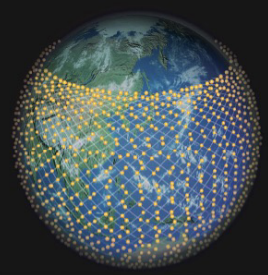
Figure: American Physical Society report “Strategic Ballistic Missile Defense: Challenges to Defending the United States.”
Figure 6 View of Earth showing the constellation of 1,600 space-based interceptors that would be required to ensure that one is available to intercept a rapid salvo launch of four Hwasong-15 ICBMs from North Korea, if the system was designed to fire interceptors almost automatically, i.e., if no time is allowed to decide whether to fire them. If instead the system was designed to allow 30 seconds to decide whether to fire interceptors, about 2,200 interceptors would be needed to ensure that enough are available to intercept such a salvo. See text for details. Adapted from [NRC 2012, Fig. 2-20].
Bio:

Dr. Laura Grego is a senior scientist and research director in the Global Security Program at the Union of Concerned Scientists. A physicist by training, she works at the intersection of science and policy on the topics of nuclear weapons, missile defense, and space security. She was recently a Stanton Nuclear Security Fellow at the MIT Laboratory for Nuclear Science and Engineering and was awarded the APS Leo Szilard Lectureship award in 2023. She is an associate editor for the journal Science and Global Security, and a Fellow of the American Physical Society and a member of its Panel on Public Affairs for six years. She has authored papers on topics from cosmology to nuclear security issues and has testified before U.S. Congress and the United Nations. Dr. Grego earned a PhD in experimental physics at the California Institute of Technology and a bachelor of science degree in physics and astronomy at the University of Michigan.
Learn More:
- See her Senior Research Director webpage of the Global Security Program at Union of Concerned Scientists (UCS): https://www.ucs.org/about/people/laura-grego
- Read her report, "The Physics of Space Security"
- Read the UCS blog: https://blog.ucs.org/author/lgrego/
- Listen to Science Friday audio segment, "The ABC's of nuclear War": https://www.sciencefriday.com/person/laura-grego/