Department Colloquium with Grace Mackenzie-Smith

Event Date:
2026-10-15T16:00:00
2026-10-15T17:00:00
Event Location:
HENN 200
Speaker:
Grace Mackenzie-Smith, Wesleyan University
Related Upcoming Events:
Intended Audience:
Everyone
Local Contact:

Brett Gladman (gladman@astro.ubc.ca)

All are welcome to this event!

Event Information:

Title:

The life and times of Drosophila melanogaster: lessons on individuality and aging from the humble fruit fly

Abstract:

Animal behavior unfolds over many timescales, from sub-second motions to circadian cycles to the lifelong process of aging. The motion of animals can be very complex, and a full quantitative description would be extremely high-dimensional. In order to study the multi-timescale structure of behavior, we use neural network-based posture estimation, spectral analysis, and non-linear dimensionality reduction to convert high-resolution video data into tractable time series of limb positions and discrete behaviors. With these data we can probe questions around the nature and time evolution of individuality, particularly with the model organism Drosophila melanogaster. Our work approaches this problem from two angles. From one side, we take recordings for the entire lifespan of Drosophila fruit flies and then quantify the hourly, daily, and lifelong patterns of Drosophila behavior. We identify the hour after dawn as a behaviorally unique moment in the circadian pattern of Drosophila, and find that certain grooming behaviors are highly correlated with individuality and lifespan. We also study the behavioral effects of two longevity-promoting drugs, rapamycin and metformin. From the other side, we examine the fine structure of behavior evolving on seconds- to hours- long timescales. We find that flies (and other organisms) can be distinguished by idiosyncratic leg sweeps during locomotion, but that a fly’s particular leg pattern is not stable throughout its life, demonstrating enough drift over 4-7 days for a fly to be classified as “completely distinguishable” from its former self. Thus we find that individuality may be lifelong or fleeting, depending on the resolution and timescale at which it is measured.

Bio:
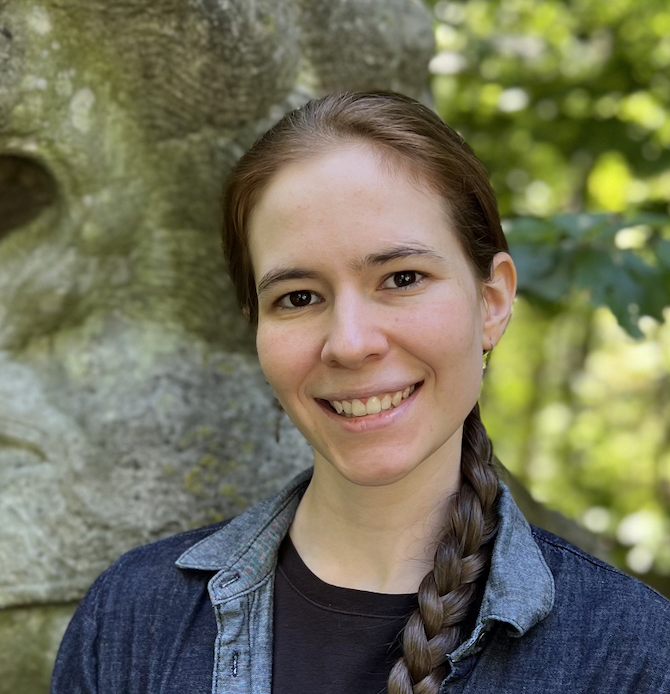
Grace earned her bachelor's degree at Bowdoin College, majoring in physics and biology (with honors), and carrying out research on fruit fly epigenetics. She completed her Ph.D. and postdoc work at Princeton University where she investigated the effects of social isolation on bumblebees and the long-timescale structure of fruit fly behavior.

Learn more:

Add to Calendar 2026-10-15T16:00:00 2026-10-15T17:00:00 Department Colloquium with Grace Mackenzie-Smith Event Information: Title: The life and times of Drosophila melanogaster: lessons on individuality and aging from the humble fruit fly Abstract: Animal behavior unfolds over many timescales, from sub-second motions to circadian cycles to the lifelong process of aging. The motion of animals can be very complex, and a full quantitative description would be extremely high-dimensional. In order to study the multi-timescale structure of behavior, we use neural network-based posture estimation, spectral analysis, and non-linear dimensionality reduction to convert high-resolution video data into tractable time series of limb positions and discrete behaviors. With these data we can probe questions around the nature and time evolution of individuality, particularly with the model organism Drosophila melanogaster. Our work approaches this problem from two angles. From one side, we take recordings for the entire lifespan of Drosophila fruit flies and then quantify the hourly, daily, and lifelong patterns of Drosophila behavior. We identify the hour after dawn as a behaviorally unique moment in the circadian pattern of Drosophila, and find that certain grooming behaviors are highly correlated with individuality and lifespan. We also study the behavioral effects of two longevity-promoting drugs, rapamycin and metformin. From the other side, we examine the fine structure of behavior evolving on seconds- to hours- long timescales. We find that flies (and other organisms) can be distinguished by idiosyncratic leg sweeps during locomotion, but that a fly’s particular leg pattern is not stable throughout its life, demonstrating enough drift over 4-7 days for a fly to be classified as “completely distinguishable” from its former self. Thus we find that individuality may be lifelong or fleeting, depending on the resolution and timescale at which it is measured. Bio: Grace earned her bachelor's degree at Bowdoin College, majoring in physics and biology (with honors), and carrying out research on fruit fly epigenetics. She completed her Ph.D. and postdoc work at Princeton University where she investigated the effects of social isolation on bumblebees and the long-timescale structure of fruit fly behavior. Learn more: See her faculty profile page at Wesleyan University: Faculty Profile  Read more from the Mackenzie-Smith lab: People – McKenzie-Smith Lab Read article "Professor Grace McKenzie-Smith on Social Perturbations in Insects and in Physics"  Event Location: HENN 200