The role of configuraitonal entropy in stabilizing materials has attracted attention in recent years. Here we explore the role of charge-entropy in stabilizing the rocksalt selenide (Ag,Sn)Se, a superconductor with valence-skipping Sn.
We compare the configuational entropy on the cation (Ag/Sn) site of (Ag,Sn)Se. We consider three possibilities: entropy from Ag/Sn atoms and two possibilities based on charge on the cations [left]. The configurational entropy dependence on composition of Ag, x, for different numbers of components, n = 2, 3, sharing the same site as a function x for a single component with all other components being equal. For comparison, we consider the charge entropy as a function of x for the case of Ag+1/Sn4+/Sn2+ and Ag+1/Sn3+/Sn2+ [top-right]. Zooming in near the maximum entropy we find the stability region (Ag,Sn)Se matches well the maximum entropy based on Ag+1/Sn4+/Sn2+ model, shaded blue region.
Non-Centrosymmetric Germenides
Broken inversion symmetry in non-centrosymmetric metals allows for exatic pairing states in the superconducting states.
Crystal structure of LaRhGe3 highlighting the broken inversion symmetry with Ge coordiation around Rh [left]. Heat capacity measurements demonstrating the superconducting transition [center], and phase diagram of superconducting state from heat capacity and muon spin relaxation experiment [right].
Distorted Square-Net Antimonides
Exploring the semimetallic and superconducting nature of distorted square-net antimonides.
Crystal structure of CaSb2 highlighting the distorted Sb sqaure-net (red atoms, Sb1), view in ac-plane [left] and ab-plane [right]. Zig-zag chains formed by Sb2 site are shown in orange, and Ca atoms shown in blue.
Antiperovskite Oxides
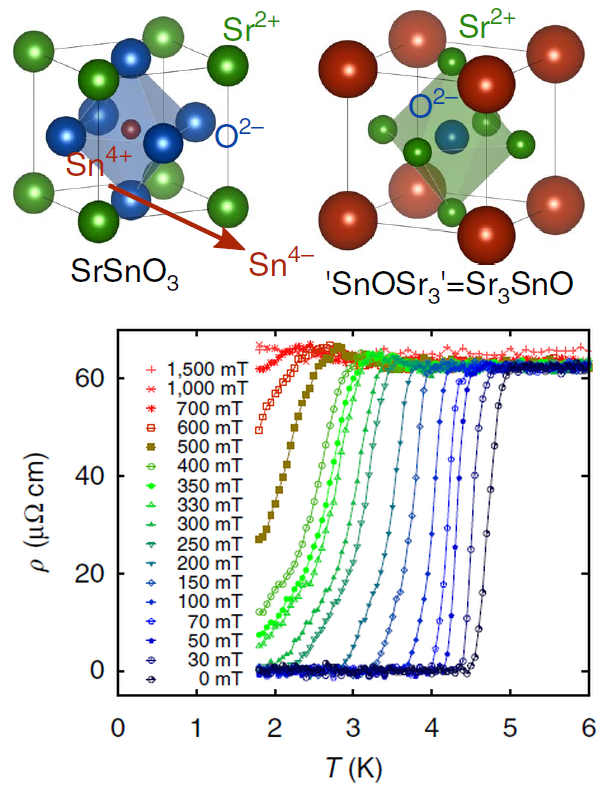
My main activity at Kyoto University was to synthesize antiperovskite oxides and handle the samples with great care to avoid decomposition in air while measuring transport and magntic properties. Superconductivity in Sr3-xSnO is reported in Nature Communications.
Comparing crystal structure of perovskite oxide (SrSnO3) and antiperovskite oxide (Sr3SnO) [top]. Showing superconducting transition in Sr3-xSnO sample with superconducting transtion at 5 K. [Bottom]
QM Group Page
Barium Copper Chalcogenides
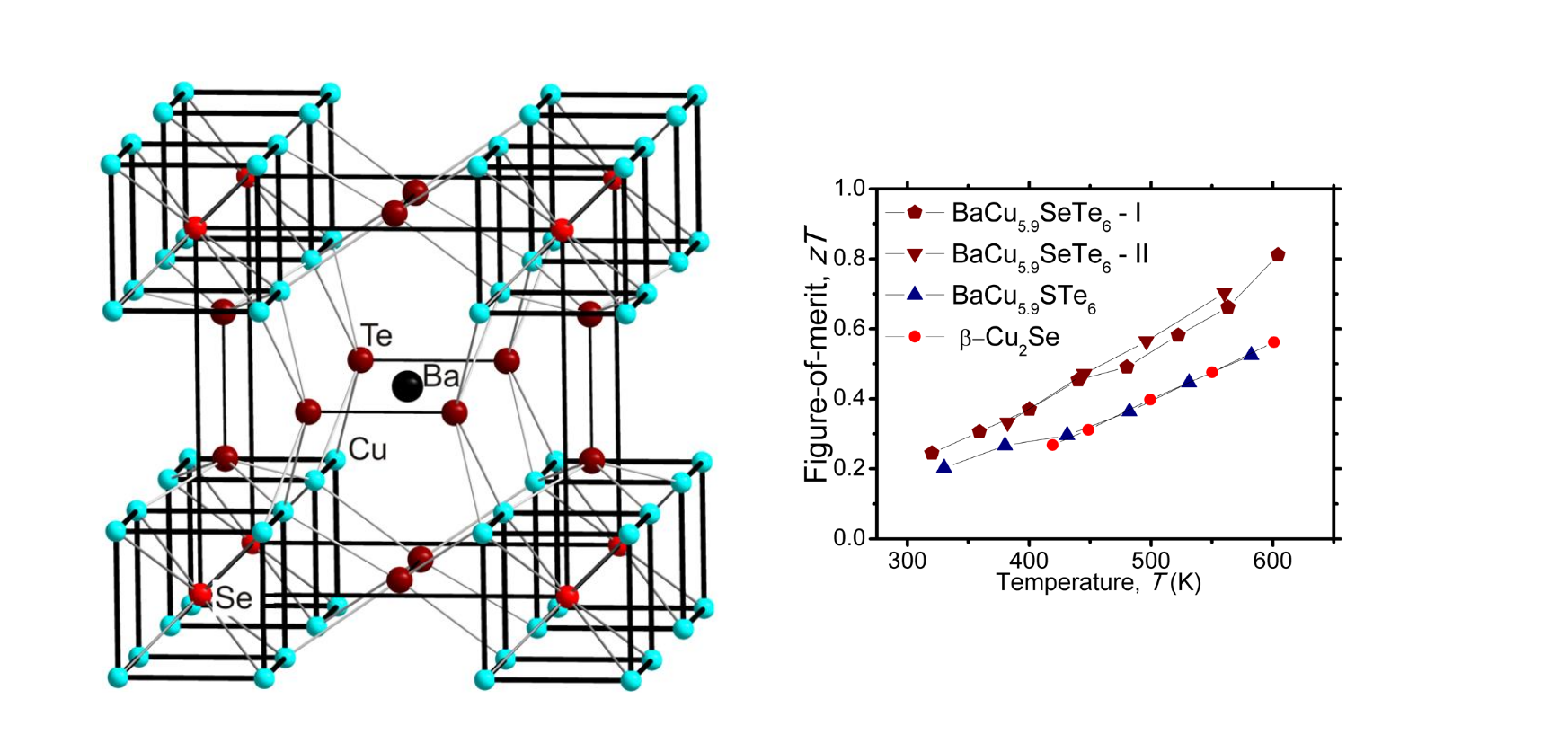
Improved efficiency of thermoelectric barium copper chalcogenides, and acheived a zT>0.8 in BaCu6SeTe6. Also, explored other transition metal chalcogenide systems while at the lab of professor Holger Kleinke.
Crystal structure of BaCu8SeTe6 (Actual compound crystalizes with 2 Cu vacancies on average)1 [Left]. Thermoelectric figure-of-merit (zT) plotted as a function of temperature for BaCu6 (S,Se)Te6.2 [Right]